Wednesday, April 6, 2011
Should Toronto Protect its View Corridors?
An article I wrote for UrbanToronto has been posted, titled "Should Toronto Protect its View Corridors?"

Sunday, March 27, 2011
Scramble Intersections
The Bay & Bloor intersection is the third intersection in Toronto feature the Pedestrian scramble. After auto and pedestrian traffic trades turns moving, there is a third pause which gives about 30 seconds for pedestrians to move across the intersection, including diagonally.
This bit of urban infrastructure is very important especially in this area where the density is high for both offices and residences. There are always more people on foot than in cars in this area.
A brilliant addition to the neighbourhood:
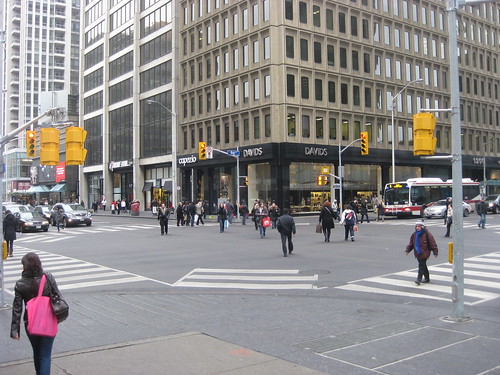
Other candidates for scramble intersections that I think could benefit Toronto include Bay St & Dundas St, Yonge St & Queen St, and Avenue Road & Bloor St.
Monday, January 3, 2011
Demolition by Neglect
A massive fire this morning at the red brick 1888 heritage building at Yonge & Gould in downtown Toronto is a major disappointment. After water, gas, and electricity had been cut from the property, and after the owners had asked and then denied to demolish the building, one wonders if foul play is involved.
The beautiful old building fell under "demolition by neglect". As part of the neglect, a part of a wall fell down in April 2010 that has caused hoarding to go up losing a car lane on Yonge and causing major pedestrian disruption along Yonge Street and Gould Street, a major entrance to Ryerson University. The owners of the heritage building, the Lalani Group should be terribly ashamed.
The Ontario Heritage Act was created to avoid these situations, and the city and province should uphold the law and make the owners pay for this. It is not acceptable.
Wednesday, December 29, 2010
Yorkville rises
Nothing over three stories existed in this photo five years ago.
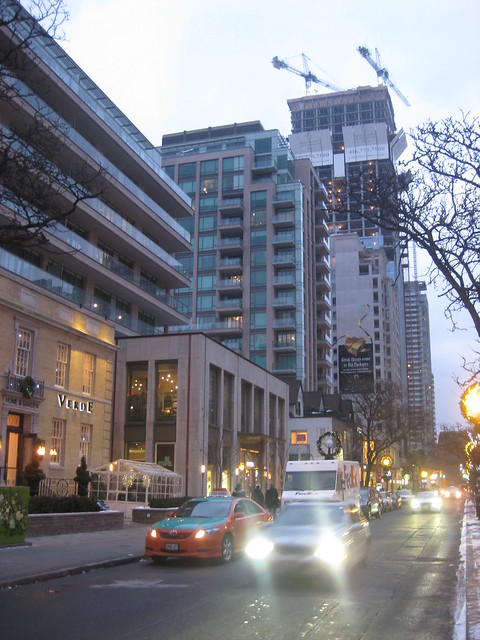
The Yorkville neighbourhood continues to grow more dense with multiple high-end condos. The building in the distance with the two cranes is the new Four Seasons Hotel, which will contain both hotel rooms and more condominium units. The neighbourhood's cozy streets filled with restaurants, boutique shopping and all the usual amenities one needs to live make it a great location, not to mention it sits above and around two subway lines.
It's a great place for a pedestrian. Since the streets are so narrow, cars drive slowly.
Tuesday, December 28, 2010
Robarts Library
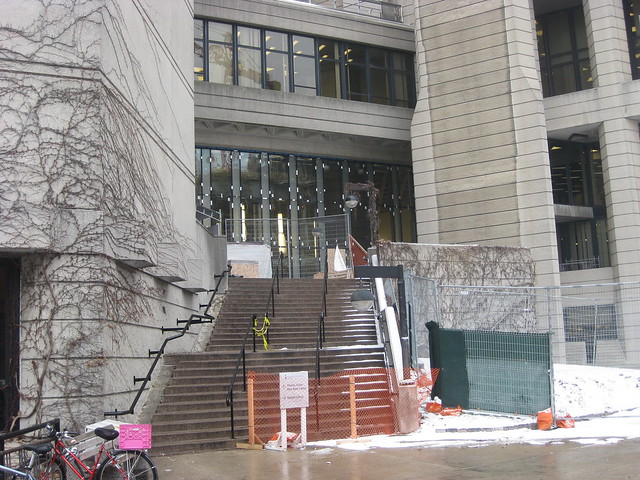
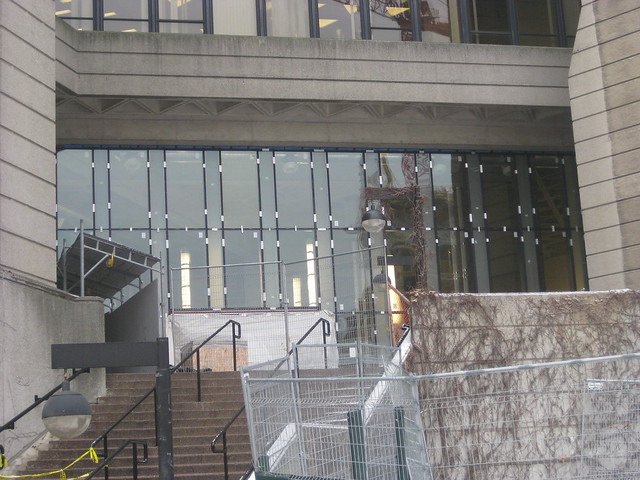
Robarts Library at the University of Toronto is adding staircases where they didn't previously exist and getting rid of its windswept 2nd floor plazas and turning them into glassed study spaces. These improvements were part of the original design of the library but were cut out due to budget constraints. The new staircase will add a new access point on Hoskin, which will improve flow to the library. The added study spaces are much needed for the large school body.


New staircase on Hoskin:
New glass with previously existing staircase on St. George Street side (additional stairs will be added here, seen in the open space on the right side of the picture):
Glass close-up:
Saturday, May 29, 2010
Downtown Living
Some interesting recent articles on downtown living:
Larger Units for a Richard Meier Condo by Fred A. Bernstein (NY Times)
"EIGHTEEN units have disappeared from On Prospect Park, the condominium building in Brooklyn designed by Richard Meier. The developer, SDS Procida, has been reworking the building’s interiors, originally expected to contain 114 units, to include more family-sized apartments. Now there are 96 units.
...Market research “showed strong demand for family-sized units” — which led to the consolidation of apartments."
----------------------------
Rethinking downtown housing by Darren Currin (The Journal Record, Oklahoma City)
"During the discussion, Craig Tucker, senior vice president of Price Edwards & Company, shared an intriguing opinion that developers and city leaders may want to rethink the way they are approaching downtown housing and consider building more affordable options first before building an excess of upscale housing options.
By having more affordable properties that attract young professionals, they may ultimately adopt a fully urban lifestyle and live in the downtown area for most of their adult lives. It would become a natural progression for downtown residents as they move from affordable to upscale housing as their careers prosper financially."
Sunday, October 18, 2009
Minneapolis Part 1: New Buildings
I recently went back to Minneapolis where I am from and took lots of photos. It was interesting to see how these buildings seemed to all be built with care and interest. For a medium-sized US city, it's important that each building stand out its own way. The IDS Center still looks fantastic, 35 years old.
Overall, the architecture was great. The planning still has some work to do. Despite its status as a very livable city, its citizens almost entirely depend on the car. The downtown population is growing, but there is still no grocery store to be found. There is a two-story Target, for what it's worth.
Overall, the architecture was great. The planning still has some work to do. Despite its status as a very livable city, its citizens almost entirely depend on the car. The downtown population is growing, but there is still no grocery store to be found. There is a two-story Target, for what it's worth.
One of the more disappointing things I saw was the single lane-ing of Lyndale Avenue. While it is turning to a nice boulevard, this would have been the perfect opportunity to add a streetcar line from downtown leading through into the residential neighbourhoods of south Minneapolis. The city has the perfect bones for a streetcar network - this was the predominant mode of transportation and how the city developed in the early 20th century. Here was a chance to bring back a bit of history and good public transit, but instead traffic calming won out. The same calming effect could have happened with laying some tracks down the middle two lanes of the street. Perhaps the city will go back to the future on another route, such as Nicollet or Lake Street.
Downtown is almost all one way streets. However, many streets are in the process of being converted to two ways. I recent poll showed about 4-5% of residents commute by bike (2nd highest in US next to Portland). There are bike lanes on major roads going through downtown.
I decided to split the pictures up into new buildings and old buildings. Minneapolis has lots of old great art deco type buildings, but also some good looking glass ones, and a few other oddities thrown in. Part 2 will feature the old ones.
Here are the "new" buildings. (All photos by me)
The skyline from a number of angles:


Nicollet Mall (Pedestrian, buses & taxis) with virtually no pedestrians on a Monday morning around 9:30 am. The existence of the skyway system puts a lot of people on the second floors of buildings downtown. This would be excellent for a place such as Hong Kong, but the dual pedestrian grid system just made the downtown feel a bit lonely.

Bus shelter with heating elements

This building always reminded me of broccoli:


How to build an interesting glass box (cut up the top):

225 South 6th St Building (I love the half halo on top):


IDS Tower:


with Target Building in the foreground:

The new downtown central library by Cesar Pelli. It's hard to tell from the photos, but the whitish glass is actually etchings of birch trees on the glass. This felt like a great public space. It is not often that new buildings give me the feeling of entering a place of great importance. This one did. Across the street there was a large parking lot that could turn into a tall residential tower with a much needed grocery store on the main floor.


The new Walker Art Center by Herzog & de Meuron. I think it looks like a Barracuda.

It's too bad that it's located right on the highway (it goes underground briefly at this huge intersection where Hennepin and Lyndale Avenues connect):

This modern beauty looks good at night:

Plaza in downtown across the street from City Hall:

I believe this used to be a government building:

McNamara Alumni Center on U of MN campus (Antoine Predock, architect):

Gehry's Weisman Art Museum on U of MN Campus:

Jean Nouvel's stunning and sharp Guthrie Theater building:


The new park next door, which was fantastic. Minneapolis sure has the magic touch when it comes to creating nice parks.

Downtown is almost all one way streets. However, many streets are in the process of being converted to two ways. I recent poll showed about 4-5% of residents commute by bike (2nd highest in US next to Portland). There are bike lanes on major roads going through downtown.
I decided to split the pictures up into new buildings and old buildings. Minneapolis has lots of old great art deco type buildings, but also some good looking glass ones, and a few other oddities thrown in. Part 2 will feature the old ones.
Here are the "new" buildings. (All photos by me)
The skyline from a number of angles:
Nicollet Mall (Pedestrian, buses & taxis) with virtually no pedestrians on a Monday morning around 9:30 am. The existence of the skyway system puts a lot of people on the second floors of buildings downtown. This would be excellent for a place such as Hong Kong, but the dual pedestrian grid system just made the downtown feel a bit lonely.
Bus shelter with heating elements
This building always reminded me of broccoli:
How to build an interesting glass box (cut up the top):
225 South 6th St Building (I love the half halo on top):
IDS Tower:
with Target Building in the foreground:
The new downtown central library by Cesar Pelli. It's hard to tell from the photos, but the whitish glass is actually etchings of birch trees on the glass. This felt like a great public space. It is not often that new buildings give me the feeling of entering a place of great importance. This one did. Across the street there was a large parking lot that could turn into a tall residential tower with a much needed grocery store on the main floor.
The new Walker Art Center by Herzog & de Meuron. I think it looks like a Barracuda.
It's too bad that it's located right on the highway (it goes underground briefly at this huge intersection where Hennepin and Lyndale Avenues connect):
This modern beauty looks good at night:
Plaza in downtown across the street from City Hall:
I believe this used to be a government building:
McNamara Alumni Center on U of MN campus (Antoine Predock, architect):
Gehry's Weisman Art Museum on U of MN Campus:
Jean Nouvel's stunning and sharp Guthrie Theater building:
The new park next door, which was fantastic. Minneapolis sure has the magic touch when it comes to creating nice parks.
Subscribe to:
Posts (Atom)